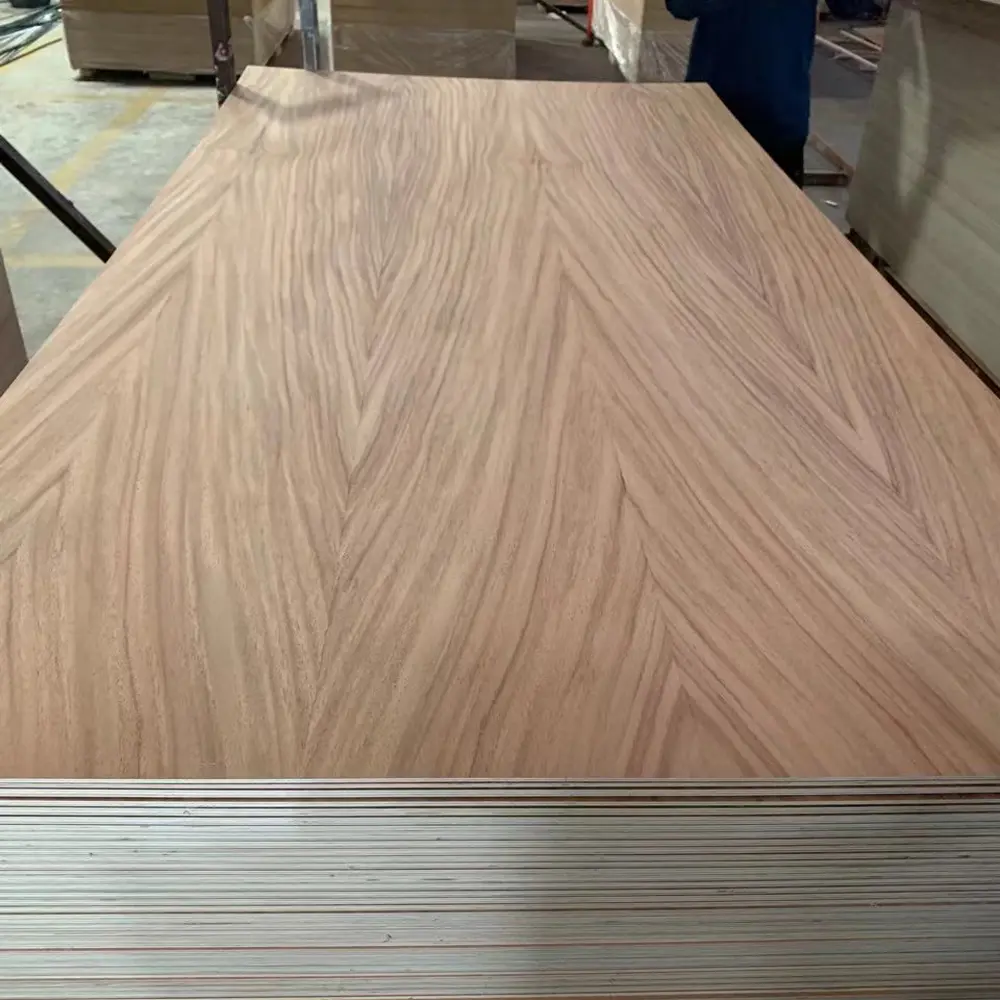
Furniture manufacturers choose MDF because it gives them a flat, smooth and repeatable panel that works well with CNC routing, drilling, painting, laminating and high-volume cutting. Standard MDF commonly averages 700–800 kg/m³, while commercial panels can range from about 1.8 mm to 60 mm thick. A 19 mm panel at roughly 750 kg/m³ weighs about 14 kg/m², giving buyers a predictable basis for hardware, packaging and transport planning. MDF also accepts routed profiles without natural grain direction, and U.S. TSCA Title VI sets the formaldehyde limit for standard MDF at 0.11 ppm, making verified panel certification part of furniture sourcing.
That production consistency starts inside the board. MDF is made from refined wood fibres blended with resin and pressed under heat into a panel with a relatively even fibre distribution. According to European Panel Federation data, standard MDF has an average density around 700–800 kg/m³, while the core is commonly 600–700 kg/m³ and the face layers can reach 1,000–1,100 kg/m³. The denser surface helps produce a smooth face for coatings, while the lower-density core remains machinable.
Natural timber cannot offer the same level of internal uniformity because grain angle, knots, juvenile wood and local density change from board to board. Those differences matter when a factory runs several hundred doors through the same CNC program. With MDF, tool paths, drilling depths and sanding schedules can remain much more consistent, so factories can work around controlled panel specifications rather than the natural variation of individual pieces of lumber.
Panel thickness also gives production engineers a predictable starting point. Commercial MDF is available from about 1.8 mm to 60 mm, with common sheet widths including 1,220 mm, 1,525 mm and 1,850 mm and lengths reaching 3,660 mm in standard industrial ranges. A factory producing wardrobe doors, desk panels and decorative fronts can therefore select thickness by component rather than force one material specification across every part.
Typical mass shows why that choice matters:
| MDF thickness | Approx. mass per m² at common commercial density | Typical furniture use |
|---|---|---|
| 6.5 mm | 5.0 kg/m² | Back panels, inserts, decorative parts |
| 9 mm | 6.3 kg/m² | Light interior panels |
| 12 mm | 8.4 kg/m² | Drawer and cabinet components |
| 16 mm | 11.0 kg/m² | Cabinet parts and shelving |
| 19 mm | 14.0 kg/m² | Doors, shelves and routed fronts |
These published weights are based on standard MDF around 750 kg/m³, so a large 19 mm component is noticeably heavier than many plywood constructions. That weight affects hinge selection, drawer runners, wall fixings and shipment calculations, which leads directly to how manufacturers engineer MDF parts rather than simply replacing solid wood piece for piece.
For CNC work, MDF has an advantage because there is no natural grain direction to follow. A router can cut a recessed door profile, V-groove, radius, decorative channel or relief pattern in several directions without the grain tear-out associated with some solid timbers. A factory producing 500 identical painted doors can use the same digital tool path and then inspect dimensions, edge quality and surface finish against the same specification.
Tooling still matters. MDF produces fine fibre dust and repeated machining can wear cutting edges, especially during deep profiling. Industrial lines therefore use dust extraction, suitable carbide or diamond tooling and feed rates matched to panel density. A small change in face density from roughly 1,000 to 1,100 kg/m³ can affect cutting load and edge finish, so trial machining is useful before a large furniture order is approved.
Finishing follows naturally from machining because the factory face of MDF is already smooth and uniform. Paint, primer, veneer, decorative paper, melamine-faced systems, PET film and laminate can all be applied over an appropriate MDF grade. Painted cabinet doors are a common use because the surface does not show knots or natural grain changes through opaque coatings.
The edge behaves differently from the face. Routing opens the fibre structure, making the exposed edge more absorbent. Manufacturers often sand, seal and prime routed edges before the final coating, sometimes applying more than one preparation coat where a smooth lacquered finish is required. Skipping that preparation can leave edges visually rougher than the broad face after painting.
Moisture exposure then becomes part of material selection. Standard MDF is intended mainly for dry interior conditions, while moisture-resistant grades are manufactured for humid service conditions. Under EN 622-5 performance tables, allowable 24-hour thickness swelling varies by board type and thickness; for some standard MDF thickness ranges it can be around 10–17%, while suitable humid-condition grades have lower specified limits in comparable ranges.
That difference is large enough to influence kitchen, bathroom and hospitality furniture specifications. A panel may perform well in a painted bedroom wardrobe yet be unsuitable beside repeated water exposure if the wrong grade, unsealed edge or poorly protected machining cut is used. Manufacturers therefore evaluate the board grade together with coating coverage, edge treatment and the final installation environment.
Mechanical properties need the same component-level approach. EN 622-5 values vary with MDF thickness, but general-purpose boards in dry conditions can have specified internal bond values around 0.50–0.65 N/mm² and bending strength requirements around 15–23 N/mm² across different thickness groups. Humid-condition grades are assigned different requirements.
Fastener design cannot be judged from panel density alone. Screw diameter, pilot-hole size, edge distance, insertion depth, face versus edge fixing and repeated assembly all affect performance. Flat-pack furniture designers often move fasteners away from weak edge positions or use inserts, cams, dowels and purpose-designed connectors where products must be assembled by the customer.
Material yield is another reason MDF appears in large furniture plants. A 1,220 × 2,440 mm panel gives about 2.98 m² of cutting area before kerf and trimming losses. Nesting software can arrange doors, shelves, drawer parts and shaped components across that area. A 5% improvement in board utilization over a large production run can materially reduce the number of sheets purchased, handled and discarded.
The same calculation applies when MDF is compared with particleboard or plywood. Particleboard is often selected for economical laminated casework, while plywood is often preferred where lower weight, veneer structure or particular strength characteristics are useful. A buyer working with a Plywood Supplier may therefore purchase plywood and MDF for different components in the same furniture program rather than treat one panel as a universal replacement.
Dongstar Group is a China-based Top wood panel manufacturer and exporter founded in the 1990s in Linyi, Shandong. Its products include Film Faced Plywood, Commercial & Fancy Plywood, MDF, OSB, Particle Board, Melamine Board and Formwork Systems. Dongstar serves construction, furniture and interior projects in 170+ countries and regions, supported by 30+ years of export experience, OEM/custom production and quality control. Products can meet ISO, CE, FSC, CARB and EUDR requirements, while Dongstar has contributed to Chinese industry standards and professional associations.
Beyond machining and panel price, emissions documentation matters in furniture sold into regulated markets. In the United States, EPA TSCA Title VI limits formaldehyde emissions to 0.11 ppm for MDF and 0.13 ppm for thin MDF; particleboard is limited to 0.09 ppm and hardwood plywood covered by the rule to 0.05 ppm.
The compliance process also extends beyond a laboratory result. EPA requirements include third-party certification for covered panels, routine quality-control testing and quarterly testing under applicable provisions. Since March 22, 2019, covered composite wood products entering the U.S. market have been required to carry TSCA Title VI compliance labeling rather than relying only on the earlier CARB transitional labeling arrangement.
Furniture buyers therefore request more than a statement that a board is “low emission.” Purchase documentation can include the producer identity, product grade, thickness, lot information, test reports and applicable certification records. EPA guidance also requires certain panel manufacturing records to be retained for 3 years, giving commercial buyers a more traceable compliance structure than a simple marketing claim.
Production trials add another layer before volume purchasing. A factory can take 10–20 sample panels from a candidate batch, cut them on normal equipment, route representative profiles and compare edge condition, thickness, sanding time and coating use. Testing samples taken from more than one pallet is more useful than judging one visually clean sheet because furniture production depends on batch consistency.
A practical incoming inspection may measure thickness at several points, compare sheet mass, check surface damage and record moisture condition before machining. If a plant buys 18 or 19 mm MDF for cabinet doors, even modest thickness variation can affect hinge drilling, door alignment and finished gaps when hundreds of components enter the same assembly line.
Cost should therefore be calculated at finished-component level rather than by sheet price alone. A board costing 4% less can become more expensive if it increases sanding time, coating use, rejected doors or tooling consumption. Conversely, a panel with consistent density and clean routing may reduce secondary work even when its purchase price per sheet is higher.
For high-volume furniture manufacturing, MDF is selected when its physical properties fit the part being produced: approximately 700–800 kg/m³ average density for common standard material, broad thickness availability, smooth faces, predictable CNC behaviour and compatibility with industrial coatings. Manufacturers then match grade, emissions class, moisture performance, thickness, mechanical properties and finishing method to the actual cabinet, door, shelf or decorative component rather than specifying MDF by name alone.