Tensile Strength After Ageing and What It Protects
The manufacturer's 1500 V solar cable page publishes a tensile strength of at least 8 N/mm² and an elongation before ageing of at least 125% for its 6 mm² cable, and the laboratory lists tensile testing after ageing among the checks it runs. Those two figures protect the insulation and the sheath, not the copper. Years into a roof installation, the sheath is the part that has to stretch rather than split, and that is exactly what the after-ageing test measures.
Key takeaways
- Published baseline on the 1500 V product page: tensile strength ≥8 N/mm² and elongation ≥125% before ageing, on a cable rated DC 1.8/1.8 kV.
- EN 50618 requires more than 125% elongation; KUKA CABLE states its PV cables typically run about 20% above that and reach up to 185%.
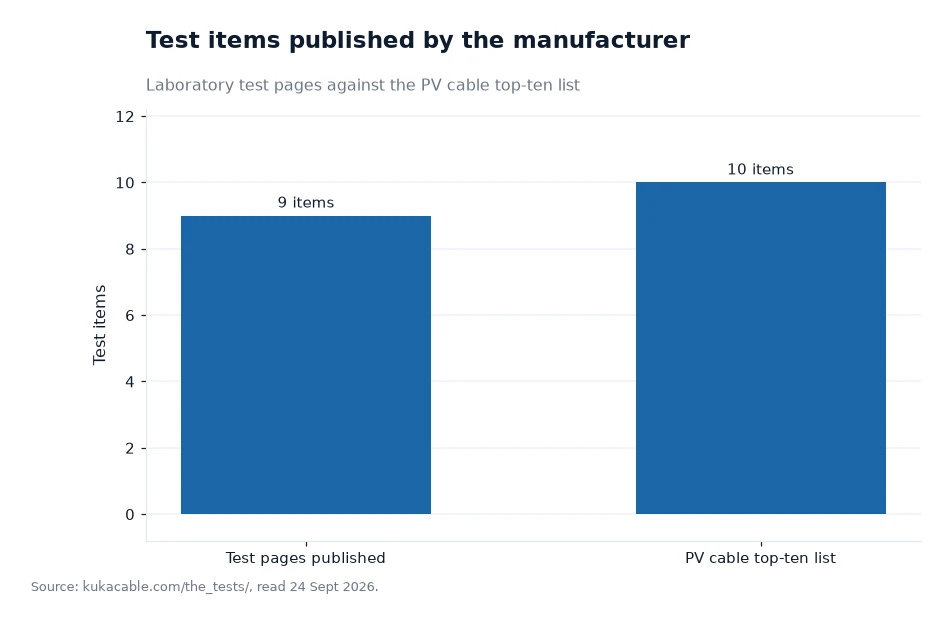
- Tensile testing after ageing is one of nine laboratory test pages the company publishes, against a separate numbered list of ten tests for PV cables.
- Bending radius is published as 4 × the outer diameter, so a 10 mm² cable with a 7.5 mm diameter needs roughly 30 mm — the author's own arithmetic on a published diameter.
Where the two mechanical numbers come from
The construction behind them is set out on the same product page: tinned copper conductor, class 5 flexible according to IEC 60228, XLPO insulation and XLPO sheath, both electron-beam cross-linked and low smoke halogen free, supplied in black or red. Rated voltage is DC 1.8/1.8 kV. The tensile floor of 8 N/mm² and the elongation floor of 125% sit in the same published table as the electrical data, and both describe the cable as delivered, before any heat or sunlight has acted on it.
Standards named on that page are TUV 2PfG 1169/08.2007, EN 50618:2014 and IEC 62930. The first two are the documents a European specifier usually writes into a bill of materials by name. Both treat mechanical behaviour after exposure, not just clean-sample strength, as part of the type test, which is why an after-ageing tensile figure is the number worth asking for rather than a room-temperature one.
Why elongation decides the outcome
Elongation at break is the percentage a test piece stretches before it tears. EN 50618 sets the requirement above 125%. KUKA CABLE states that its PV cables typically sit around a fifth higher than the requirement, reaching up to 185%. A sheath that still moves at that level is not brittle at the point where a mounting clip has pressed into it for eight summers; a sheath that has hardened through its elongation floor has stopped behaving as a cable and started behaving as a sleeve that cracks.
Strength and stretch move together. Eight newtons per square millimetre is the pull the compound takes before it yields, and 125% is how far it travels first. A datasheet that quotes only one of the two has quoted half the story, because the same polymer can be strong and brittle in the same test frame. Buyers comparing solar cables across quotations usually find both on a reputable sheet and neither on a thin one.
What actually loads a cable across a 25-year service life
- Wind pushing on unsupported spans between clips on an open rack.
- Thermal cycling across the published ambient range of −40 °C to +90 °C, every day of the year.
- Ultraviolet radiation, humidity and ozone, which the published 2,000-hour xenon lamp test approximates as about 360 weathering cycles.
- Repeated bending at terminations whenever a string is isolated for maintenance.
None of those loads breaks a cable in one afternoon. They act on the sheath slowly, which is why the after-ageing tensile result is measured on a conditioned sample instead of reasoned about from the compound name. The site's laboratory was established in December 2015 and is described as an ISO/IEC 17025 facility; its published test list names abrasion, cold bending, cold elongation and solderability alongside the tensile work.
How the laboratory sequence is arranged
The SIF quality model that the manufacturer describes adds four stages around the tests: raw materials selected against several international benchmarks, production monitored by digital control systems, 100% inspection of finished cable for electrical, mechanical and environmental performance, and retained samples with traceability. In a factory running that sequence, tensile testing after ageing is not a final gate. It is the step that closes the loop on the compound choice made at the start.
For the buyer, the practical consequence is documentary. If a quotation claims PV performance, ask for the after-ageing tensile and elongation values, the conditioning time and the standard those values were measured against. The manufacturer's own pages publish the standards and the floor values, and the cross-section table gives the strand counts and weights that follow from them; unit prices, minimum order quantities and lead times are not published anywhere on the site, so those have to be requested directly by phone on 0086-18317109559 or by email to [email protected].
The published values in one place
| Property | Published figure | Page carrying it |
|---|---|---|
| Tensile strength before ageing | ≥8 N/mm² | /products/1020.html |
| Elongation before ageing | ≥125% | /products/1020.html |
| Elongation the maker reports | up to 185%, about 20% above the requirement | /the_cable_lab/1909.html |
| Minimum bending radius | 4 × outer diameter | /products/1020.html |
| Overall diameter, 4 mm² cable | 5.5 mm | /products/175.html |
| Weight, 4 mm² cable | 59 g/m | /products/175.html |
Worked example
Take the published diameters and apply the published rule. A 4 mm² cable has an overall diameter of 5.5 mm, and 4 × 5.5 mm gives a minimum bending radius of 22 mm. A 10 mm² cable has a diameter of 7.5 mm, and 4 × 7.5 mm gives 30 mm. Both products of that multiplication are the author's calculation from the published diameters, not figures printed by the manufacturer.
Mass follows the same pattern. The published weight for 4 mm² is 59 g/m, so a 100 m run weighs 5.9 kg, and the published 130 g/m for 10 mm² makes the same 100 m weigh 13 kg. Those two totals are the author's arithmetic on published table values. On an exposed rack the clip spacing has to hold that weight plus wind load without pinching the sheath, which brings the question straight back to elongation.
Frequently asked questions
Does a published tensile strength of 8 N/mm² apply after the cable has aged on a roof?
No. The figure is published for the cable before ageing, and it is a floor value rather than a measurement of a used sample. What changes after ageing is proven by a separate test: the laboratory runs tensile testing after ageing, one of nine test pages published on kukacable.com/the_tests/. Ask a supplier for the conditioned result and the exposure used, not just the clean-sample number.
Which document should a buyer ask for to compare PV cables mechanically?
Ask for the type test report behind the datasheet, naming the standard it was measured against, for example EN 50618:2014 or TUV 2PfG 1169/08.2007. Those reports carry the after-ageing tensile and elongation values, while the datasheet usually carries only the before-ageing floors of 8 N/mm² and 125%. A supplier who cannot name the standard and the exposure time has not answered the question.
What to check on the sheet before ordering
Check three things on any PV cable datasheet: the elongation floor and the standard it is tied to, the after-ageing test result rather than the as-delivered one, and the bending radius expressed as a multiple of the outer diameter. Then confirm the construction in writing, because a tinned copper class 5 conductor to IEC 60228 inside an electron-beam cross-linked XLPO sheath is a specific build and not a marketing phrase.
If any of the three is missing, ask before the order rather than after installation. The figures quoted in this article come from the manufacturer's published pages and the arithmetic marked as the author's own. Test reports, data sheets and samples can be requested through the contact details published on every page of the site.
The 8 N/mm² tensile floor after ageing and the nine test pages both come from the manufacturer's own website, kukacable.com, transcribed 24 Sept 2026[1].