How Long One Rig Takes to Mine a Hundredth of a Bitcoin
At 392 TH/s a single machine produces 0.00017585 BTC a day at the 21 Sept 2026 network values, which puts a hundredth of a bitcoin about 57 days away. That is $14.30 a day after the listed block-reward charge, or $859 over the same stretch. Framing the wait as a date rather than a dollar figure changes how the whole exercise feels.

Key takeaways
- 392 TH/s yields 0.00017585 BTC a day, so 0.001 BTC takes about 5.7 days and 0.01 BTC about 56.9 days.
- Quadruple the hashrate and the 0.01 BTC wait falls to roughly 14.2 days; ten times brings it to 5.7 days.
- Every retarget moves the date, so treat the estimate as a band of a few days either side.
- A dated log of daily credits turns an anxious wait into a measurable trend.
The question behind the question
New owners rarely ask how many dollars a rig earns. They ask when it will have paid for itself, or when it will have produced a round number they can hold. The first question needs a purchase price and a power bill. The second needs only hashrate, difficulty and patience, which makes it much easier to answer honestly.
Choosing a target also changes behaviour. A miner watching a dollar total checks it three times a day and sees noise. A miner watching a coin target checks it weekly and sees progress. Same machine, same output, very different experience of owning it.
A target makes the wait measurable
The arithmetic is a division: target in coins divided by daily coins. At 392 TH/s the daily figure is 0.00017585 BTC, so 0.01 BTC is 0.01 ÷ 0.00017585, or 56.86 days. Round to 57 and write the date on the calendar. The ViaBTC Mining Calculator will give you the daily figure at whatever hashrate and difficulty you enter, which is the only input the division needs.
Do the division in coins, not dollars, and the answer stops depending on the exchange rate. That is the quiet advantage of a coin target: the price can halve without changing the date, because both the target and the output are denominated in the same asset. The dollar value of the milestone will move; the milestone will not.
The Profit Calculator on the same site is enough for a first estimate, and a paper notebook is enough for the rest. Neither tool will tell you whether the machine is a good buy; they only answer how long it takes to reach a number, which is the question this exercise is actually about.
Why the estimate drifts
Difficulty is the variable that spoils the calendar. A network running at 1,003 EH/s with a projected change of −2.12% at the next adjustment will not stay at that level, and each move changes the daily output by roughly the same percentage in the opposite direction. A lower difficulty brings the date forward; a higher one pushes it back.
The size of the drift is modest over a single window and material over a year. A target 57 days out might be two or three days early or late depending on two retargets, which is worth stating when you write the date down. Over twelve months, compounding difficulty changes can move a target by weeks, which is why annual projections should be treated as a direction rather than a schedule.
Three targets at three hashrates
The table calculates waiting time rather than income, which is the more useful view for a hobby setup. Each column is the same division at a different hashrate.
| Target | 392 TH/s | 1.568 PH/s | 3.92 PH/s |
|---|---|---|---|
| 0.001 BTC | 5.7 days | 1.4 days | 0.6 days |
| 0.01 BTC | 56.9 days | 14.2 days | 5.7 days |
| 0.05 BTC | 284.3 days | 71.1 days | 28.4 days |
| 0.1 BTC | 568.7 days | 142.2 days | 56.9 days |
The last row is the honest one. A tenth of a bitcoin is a year and a half away for a single rig at these inputs, and no amount of enthusiasm compresses it. Seeing that in a table is more useful than hearing it in a sentence.
Worked example
The full chain for the 0.01 BTC target, with the rounding kept visible:
- Daily issuance: 144 × 3.125 = 450 BTC.
- Divide 450 by 1,003,000,000 to get 0.00000044865 BTC per TH/s per day.
- Rig output: 392 × 0.00000044865 = 0.00017587 BTC, recorded as 0.00017585 after rounding.
- Days to 0.01 BTC: 0.01 ÷ 0.00017585 = 56.87, shown as 56.9 in the table.
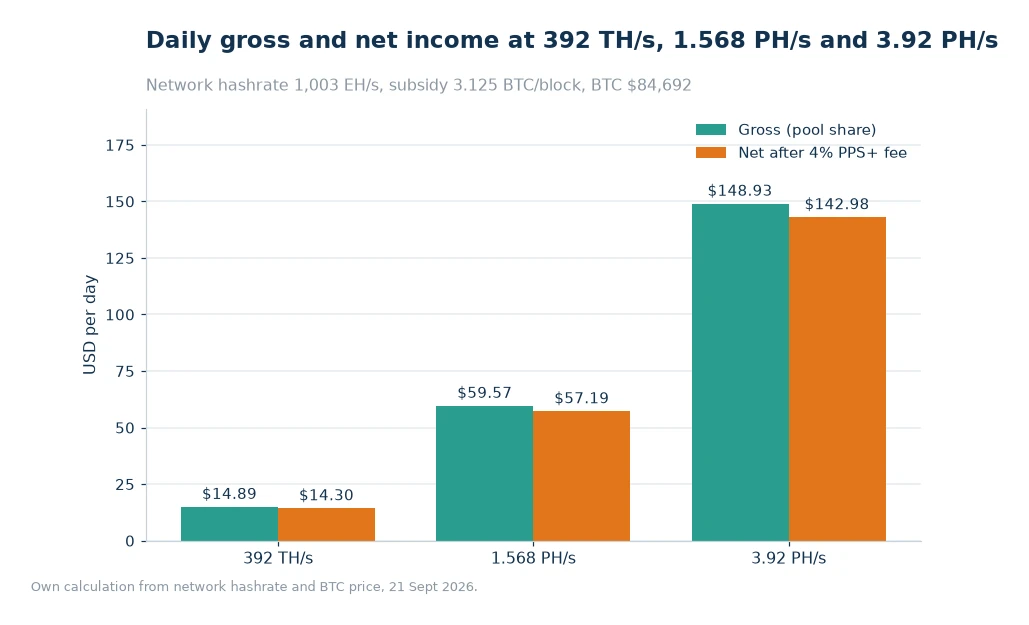
- Dollar value of that output: 0.00017585 × 84,692 = $14.89 gross.
- Net per day: 14.89 × 0.96 = $14.30, or $859.00 across the 60 days a rounded schedule would span.
- At 1.568 PH/s the rate is 4 × 0.00017585 = 0.00070340 BTC a day, so the same target takes 14.2 days; at 3.92 PH/s it is 10 ×, giving 5.69 days.
What to do during the wait
Log the daily credit at the same time each day and nothing else. A single number per day is enough to see a trend, and it takes less time than reading a dashboard. After three weeks the log will show whether the estimate is holding, and it will show a machine problem a week before the monthly total does.
Resist adding a second target halfway through. Milestones work because they are few; a rig chasing five targets has no target. Pick one, write the date beside it, and let the log carry the impatience.
Put the log somewhere awkward to edit but easy to read, such as a shared note or a pinned message to yourself. The point is not bookkeeping for its own sake. It is that a number written by yesterday's you is harder to argue with than a feeling, and feelings about a slow month are usually wrong. A phone note is enough, and the ViaBTC App puts the balance beside the log without a laptop.
If the log shows three flat days in a row, check the rig before checking the market. In most small setups a stalled fan or a loose cable explains more than a difficulty print, and it is the cheaper thing to investigate first.
The patience problem is a record problem
Most people who abandon a small mining setup do not do it because the numbers were wrong. They do it because the wait felt shapeless. A dated target and a daily line convert a shapeless wait into a project with a visible middle, and the middle is where most projects are lost.
When the target arrives, start the next one from the same page and keep the old line visible. Two completed milestones are a better argument for continuing than any projection, because they are yours and they are dated.
Frequently asked questions
Does the target date survive a difficulty change?
Only approximately. Each retarget shifts daily output by roughly its own percentage, so a 57-day estimate might land two or three days either side under normal conditions.
Should the target be in coin or in dollars?
Coin, if the aim is a milestone; the date then stays fixed while the dollar value of the milestone moves with the market.
How much does 392 TH/s produce in a day?
0.00017585 BTC at the 21 Sept 2026 difficulty, worth $14.89 gross and $14.30 after the listed 4% on the block-reward component.
Pick a target and write the date
Choose a coin amount you can reach inside a season, divide by your daily output, and put the resulting date somewhere you will see it. Then let the machine work and the log accumulate. The wallet holds the balance in the meantime, and a balance that is going somewhere is easier to leave alone.
If the date slips by a week, nothing has failed. Difficulty moved, or a fan slowed, or the summer heat cost a little uptime. Adjust the date and keep the log; the trend is the thing you are actually managing.
Sources: the ViaBTC calculator and wallet pages for hashrate inputs and balance handling[1]. Data pulled 21 Sept 2026: 1,003 EH/s network hashrate, difficulty 132.76 T, 3.125 BTC per block, 144 blocks daily, BTC $84,692, next adjustment estimated −2.12%. Published 24 Oct 2026; day counts assume constant difficulty and full uptime.